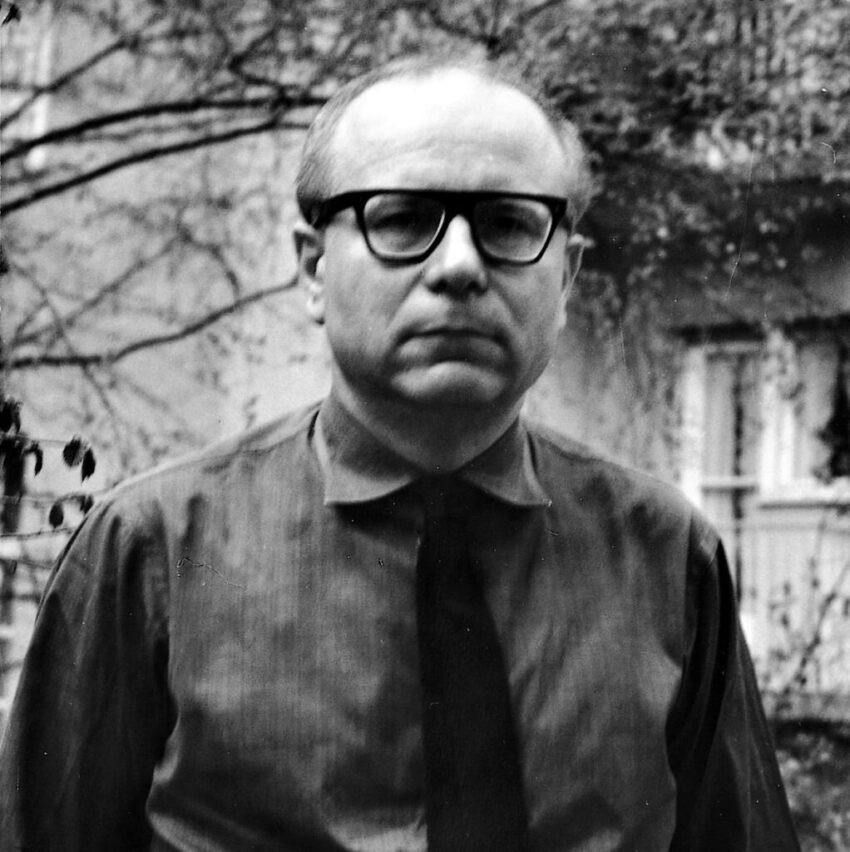
© Suhrkamp Verlag, courtesy of New Directions.
Wolfgang Koeppen, the maestro dirigent of the post-Nazi German-language novel, was born in the cold old Prussian port of Greifswald in 1906, a bastard, as they used to be called, the out-of-wedlock son of a seamstress who moonlit as a theater prompter and an ophthalmologist father, who dabbled in winter sports and competitive ballooning and refused most contact. Mother and son moved around a lot, from Koeppen’s grandmother’s house to the house of his mother’s stepsister. In 1912, the year Death in Venice (not Death in Rome) was published, the pair settled in Ortelsburg, Masuria, which is now the Polish city of Szczytno, where Koeppen attended Realschule. Mother and son fled west with World War I, heading along the Baltic coast until returning to Greifswald, where Koeppen made efforts to resume his schooling before dropping out totally and working as a deliverer for a bookstore, a cook, a ship’s cook, an assembler in factories, a theater usher, a movie theater usher, a projectionist, an ice maker and deliverer, and a tester of light bulbs. Each of these occupations, it might be argued, is a metaphor for “novelist”: delivering the books, preparing nourishment, et cetera. They certainly provided what in German industrial circles is called “material.”
In 1931, Koeppen washed up, or down, in Berlin, and began contributing articles to the liberal-left Berliner Börsen-Courier, which eventually put him on staff, a precarious position that ended when the paper was shuttered by the Nazis on the final day of 1933—not an auspicious time to be launching a German-language literary career.
The man was an anachronism: born too early or too late. He’d come into his thirties during the Third Reich, and with a sensibility already matured through interwar Modernism, the homegrown Döblin and Becher, the Austrians Broch and Musil, and the experience of having been among the very first readers of Proust, Faulkner, Woolf, and Joyce in German. To be sure, when his journalism stint came to a close and he turned his calloused hand to fiction, he seems to have realized how desynchronized he was and set himself to writing two novels with then-approachable touches of socialist realism (not national socialist realism), akin to the working-class work of that fellow son of Greifswald, Hans Fallada: the love-lost account A Sad Affair (1934) and the bleak pastoral Die Mauer schwankt (The tottering wall, 1935).
At the same time as he started publishing, however, Koeppen tried to make a break with Germany and followed his Jewish publishers and many of his Jewish and left-liberal friends to Holland, which served as a temporary refuge for some who wound up leaving the continent altogether and for others who wound up being dragged off to Poland. Koeppen did, or suffered, neither. Instead, he—who reviled the Nazis—decided to leave the Hague and go back to the Reich, repatriating in 1938. It might be hard to understand this choice in retrospect, but I imagine in the moment it felt inevitable. Koeppen was no cosmopolitan. He was a monoglot, an obscure fatherless Eastern boy, holes in his pockets, holes in his shoes. He was never going to live in sunny California exile and be Thomas Mann or even Heinrich Mann.
Taken as a whole, Koeppen’s activities during World War II seem a canny exercise in self-sabotage that was also self-defense. The scripts he wrote and helped to write for UFA and Bavaria Filmkunst were almost never produced, but his employment got him cover. The propagandistic (or so it was described) novel he signed on to write never got finished, but the contract earned him a deferral from military service. An Allied bombing run in Berlin gave him the opportunity to essentially fake his own death, and he spent the last years of the war underground, or at least hiding out in a ramshackle hotel near Munich, where he married the proprietor’s sister, Marion. Following the war, the couple eked out a living selling antiques (looted, stolen, abandoned), while Koeppen also drudged freelance as a ghostwriter, most notably on the memoirs of a German Jewish postage stamp dealer named Jakob Littner who’d been through the ghetto liquidations. Koeppen edited, revised, and some would say completely rewrote Littner’s manuscript in exchange for bimonthly care packages the man sent from his new life in New York. Hoarding tinned fish and canned ham, Koeppen also hoarded experience: there is the sense that his entire life up until the fall of the Reich was all a vast batteric accumulation of power, a rag-and-bone collecting of resources, from his jobbing and hustles, from theater and film, from the Nazis and Jew who employed him.
The great discharge of these energies came only in the fifties, the decade of total division and partial denazification when Koeppen began writing fiction again—writing quickly to be read quickly, books that made speed their governing principle. It’s unclear to me—and it was probably unclear to Koeppen himself—what caused this abrupt fecundity: possibly a desire to novelize the novelties of a Germany that was suddenly West Germany, possibly the more quotidian fact that he met a publisher, Henry Goverts, who upon returning from exile was interested in Koeppen’s work. Whatever the reason—I’m not sure it’s useful to insist on a reason—the man was writing like his typewriter was on fire and in flaming succession produced three books that have been called a trilogy through proximity alone. With no incidents or characters connecting them, with no single style even linking them, they are a trilogy simply because they were written one after another—written as though enjambed—and represent the only fiction that Koeppen would publish postwar, though he continued to live for long, silent nonfiction decades and died in the nineties, just after the fall of communism.
Pigeons in the Grass, with a title from Gertrude Stein, was published in summer 1951 and, Ulysses-like, follows dozens of characters but especially a Black American serviceman named Odysseus through a single day in spring 1948 in Munich. The Hothouse, published in fall 1953, follows a suicidal West German politician over the course of two days and two nights in spring 1953 in Bonn. And Death in Rome, published in fall 1954, takes the reader to a Nazi family reunion-cum-Roman holiday lasting three days in spring 1954.
It’s this family element that most clearly sets Death in Rome apart from the Mann classic referenced by the title and often lampooned within the text. Both books traffic in the German cathexis with Italy, the Teutonic concept of the Mediterranean cradle of the Imperium as the primal site of warm abandon, where pale and dutiful burghers can go to tan amid the ruins, spice up their bready palates, and fall in love or just lust as a supposedly acculturating stop on the Grand Tour. But that is where the similarities between these thanatoid fictions end, because while Mann focuses on a solitary genius reckoning with his decadence, Koeppen homes in on a busy klatch of already decayed relations, a dark-comically caricatured cohort of Nazi normies who’ve come to the balmy capital of post-Mussolini Italy to cut loose from throat-cutting (and to say a little prayer and make a little night music).
Gottlieb Judejahn is the patriarch: note the Jew in his name and wonder (as translator Michael Hofmann has pointed out) whether the jahn references Wahn, madness, or jäten, to weed out or extirpate. He’s an unrepentant former SS man whose résumé takes in pretty much every major German twentieth-century travesty: the Freikorps, the Black Reichswehr, and so on. Sentenced to death in absentia at Nuremberg, he has somehow escaped to an Arab country—either Egypt or Jordan, it was never clear to me—where he works as a military consultant helping to plan the destruction of the State of Israel. His presence in Rome is both business and pleasure: between Baedeker tourism and catching up with family, he has a sit-down with some arms dealers to make a purchase. Judejahn and his wife Eva have a son, Adolf, who wears another uniform: he’s a trainee priest affiliated with the Vatican, seeking salvation from his father’s crimes in religion, but troubled by the Church’s relationship with the Reich. Judejahn’s brother-in-law is Friedrich Wilhelm Pfaffrath, a former front man for Nazi manufacturing, since reformed into a Burgomaster and Bundesrepublik caudillo convinced he has enough clout to get Judejahn pardoned and readmitted into the country. Pfaffrath is married to Eva’s sister, Anna, and they have two sons: Dietrich, a careerist law student destined to become a version—and given that he should know better, an even more malicious version—of his father, and Siegfried, a serialist composer who gradually becomes what has to be considered the novel’s hero. He, like Mann’s von Aschenbach, is a homosexual and a pederast, a writer not of prose but of the so-called dodecaphonic music espoused by the Viennese school of Schoenberg, Webern, and Berg. His music, an ostensibly logical rational transposition of the world’s dissonance, provides the most superficial occasion for the reunion: a performance of his new symphony, which has won a prize. Though Siegfried professes to hate the piece, it is being performed at a concert under the baton of the conductor Kürenberg, whose Jewish wife Ilse becomes a target of Judejahn, Siegfried’s uncle …
Such is the cast that meets and parts, meets and parts, as the characters insinuate themselves like musical leitmotifs in and out of the Roman vias, confronting German-Roman history ancient (Alaric the Goth) and modern (fascism), in a mad allusive style that takes its cues from music: patternization, systemization, theme, and variation.
Musicality is a neglected attribute of prose, and when it’s evoked as a description, usually by the deafer critics, it’s used as a hazy-daze-y indicator of sentences that sound good: alliteration, assonance, some poetry-like balancing of the sonic surface. But Koeppen’s musicality goes deeper than that: it’s structural. The clause is the unit, which Koeppen deploys in canon and manipulates by the principles of fugue, creating sentences that sing in a complex orchestration of what’s essentially contrapuntal voices. That makes this book a masterpiece in German, but fiendishly difficult to translate, though I hope you’ll agree that Michael Hofmann has performed a near miracle, reinventing the colorations for English while preserving the formal architecture in all its modulations, as in the following passage:
and the two of them, two firm silhouettes, had stepped up to the window, the tall French window, and they looked down into the illuminated pit of the street below, and they looked across at other hotels like their own in many-storied stone buildings by the station, full of travelers, electrical signs flashed their temptations, and Rome was ready as ever to be conquered, and Kürenberg was thinking about Siegfried’s music, the flow of feeling he wanted to tighten and compress and cool for this city tomorrow, and Ilse stood beside him and looked at the roofs of automobiles creeping along the bottom of the street like an armored column of cockroaches, she saw the brief, harmless flash of lightning in the wires over the electric trolleybuses, she saw through the convention of pretending death didn’t exist, the unanimous agreement to deny terror, the ownership of the buildings she saw was set out in the land register, and even the Romans, well acquainted with ruin and the devastation of former splendor, believed in the everlastingness of this particular arrangement of stones on the old earth, she saw the mystery plays of trade, these also based on the delusions of eternity, inheritance and certainty, she saw the blooming and withering miracles of advertisements, whose colors had played on her own childhood too, quicksilver lights or dragon candles, and how simpleminded of her father it had been to put up a wall of books, music and art between her girlish life and the store, a false bastion, mild lamplight extinguished forever.
Here in this stretch that I’ve picked almost, but just almost, at random is Koeppen/Hofmann at their best. Putting aside a comparison with the original, let’s stay in this English transcription where the two of them, the bassoons might say, two firm silhouettes, the flutes might add, step up to the window, the cellos declare, the tall French window, the violins correct, and they look down into the illuminated pit of the street below, like an orchestra’s pit, but here the orchestra is lit and center stage. The theme, or countertheme, of Roman history is introduced before the conductor himself enters to think about Siegfried’s music, rather to think about how he wants Siegfried’s music to sound, though just as his thoughts coalesce and focus, Ilse brassily steps out from the wings to pick up the Roman motif and run with it, straight into the wall of her bourgeois childhood. The virtuosity on display here is emblematic of Koeppen, whose technique bears beauty as an entr’acte between the world’s recurrent slaughters.
An excerpt from Joshua Cohen’s introduction to Wolfgang Koeppen’s Death in Rome, translated from the German by Michael Hofmann, which will be published by New Directions in May.
Joshua Cohen was awarded the Pulitzer Prize in Fiction for The Netanyahus: An Account of a Minor and Ultimately Even Negligible Episode in the History of a Very Famous Family.
Sports News
website focused on news and information about the world of football. This is one of the popular websites in Indonesia accessed by sports fans, especially football enthusiasts, to get quick and reliable information.