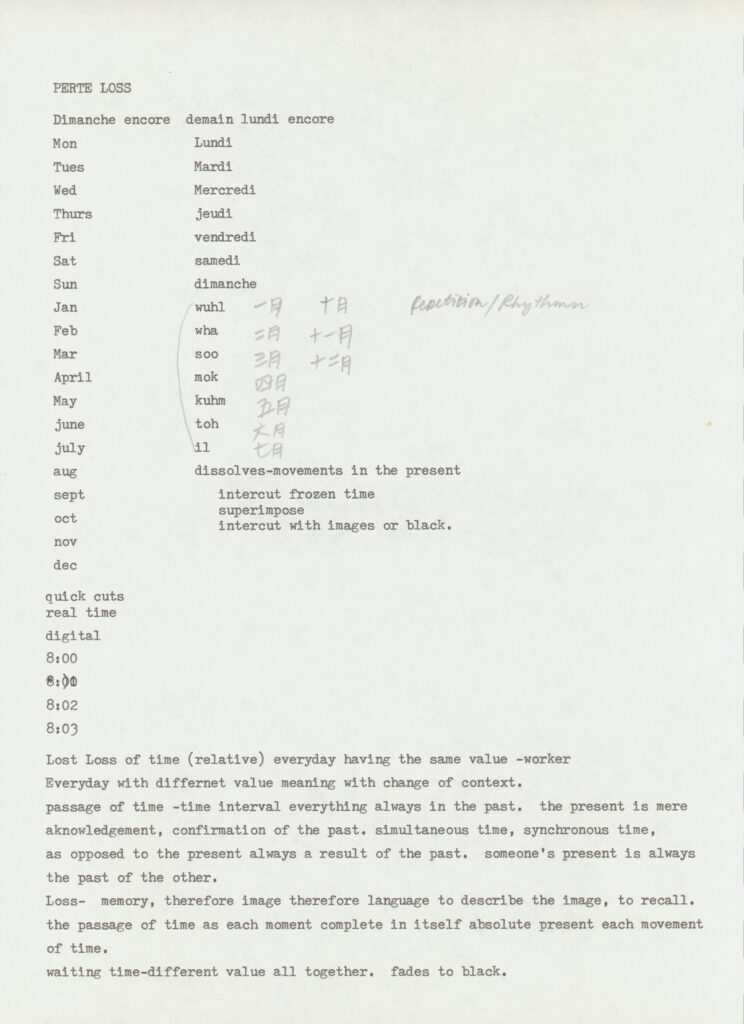
From Perte Loss, 1979. University of California, Berkeley Art Museum and Pacific Film Archive; Gift of the Theresa Hak Kyung Cha Memorial Foundation.
In 1979, Theresa Hak Kyung Cha submitted a proposal for a two-channel video performance titled Perte Loss to the San Francisco–based collective Video Free America. The performance, she explained, would explore multiple valences of the French word perte: “loss, articulated as memory, time, image, etc within the duration of the piece.” One channel, representing the present, would consist of moving images and words in the present tense. The other would represent the “memory for / of channel #1” and would consist of still images and words in the past tense. The artist herself would mediate between the two channels, appearing behind glass as “a video image” and incorporating performance, still and moving image, and both live and recorded sound to evoke the process of “giv[ing] life to what is fixe, mort, by remembering.”
Two months before she was scheduled to perform the piece at Video Free America as part of a group show of “Video Performance Art,” Cha formally withdrew from the exhibition due to a lack of both financial and philosophical support. “I have no desire or need to make compromises on the conceived project, for it to completely transform itself into no longer the same piece,” she explained. She would not live to realize the piece in its originally intended form.
The brutal fact of Cha’s rape and murder in New York in 1982 is an irreducible part of the encounter with her work, yet it is not the only way Cha’s archive prompts us to reckon with incompletion. Cha experimented with an aesthetics of fragmentation and ellipsis; ideas and forms recur and evolve across projects, inviting us to undo the commonplace divisions between unfinished and finished works and to instead see them as part of one continuous creative practice.
While Perte Loss was not intended as a textual piece, its script displays the fascination with language for which Cha is well known. She experiments with the visual spacing of words on the page and employs repetition and recombination to evoke gaps in memory and the longing to recall what has been lost. Perte Loss begins by naming days of the week, months of the year, and the minutes passing by on a clock in multiple languages: English, French, transliterated Korean, and, in her handwritten addendum to the proposal, Chinese script. Each linguistic track operates at a slight dislocation from the other, a gesture she frequently explored when working with multiple languages—here, the Korean days of the week are paired with English months of the year; next to them, Chinese characters name the months of the year again, but August and September are left out. A supplementary text, likely intended for the vocal track of Perte Loss, extends this interest in verbal permutations. She writes:
you are missing
you don’t know what
you are
missing
Cha reimagined and expanded the ideas in Perte Loss in her proposal for a feature-length film, White Dust from Mongolia (1980). The film centers on an unnamed amnesiac’s process of retrieving memory and speech. In Cha’s script, the dual channels of Perte Loss are reinvented as two simultaneous narratives that meet over the course of the film. One, set in the past, takes shape within the mind of Character #1, the amnesiac, and suggests that the causes of her amnesia stem from Korea’s traumatic histories of Japanese imperial and U.S. military occupation. The second narrative, set in the present, follows Character #2, who “returns” and “gives memory” to Character #1, establishing her identity in an interrogation and reintroducing speech through linguistic instruction. In the final scene, the amnesiac’s retrieved memories appear as filmic images projected in an abandoned movie theater; she walks toward the screen, physically entering it.
Cha did not complete White Dust from Mongolia; her plan to film in Korea was interrupted by political unrest in the wake of President Park Chung-hee’s assassination and the massacre of student protesters in Gwangju. But references to exile and linguistic alienation under imperial rule, and imagery of an unnamed woman’s hypnotic suspension before the cinema screen, echo across Cha’s polyvocal literary experiment Dictée (1982).
Rather than suggesting a teleological development toward a final masterpiece, Cha’s unfinished projects exceed such ready-made routes. Cha’s outline for Perte Loss ends with “sheets of tissue paper strewn across the floor” stirred up by a changing wind, heralding an “alchemical process” of transformation. Alchemy was also Cha’s favored analogy for the artistic process itself: The artist’s “vision belongs to an altering, of material, and of perception,” she wrote. To traverse Cha’s archive is to register the force of an artistic imagination that is itself not “fixe, mort” but constantly mutating.
Transcription Notes:
(words in parentheses denote Cha’s handwritten addendums)
— indicates original page breaks in proposal
PERTE LOSS
Dimanche encore demain lundi encore
Mon Lundi
Tues Mardi
Wed Mercredi
Thurs jeudi
Fri vendredi
Sat samedi
Sun dimanche
Jan wuhl ( 一月) (十月) (Repetition/ Rhythmn [sic])
Feb wha (二月) (十一月)
Mar soo (三月) (十二月)
April mok ( 四月)
May kuhm ( 五月)
june toh ( 六月)
july il ( 七月)
aug dissolves-movements in the present
sept intercut frozen time
oct superimpose
nov intercut with images or black.
dec
quick cuts
real time
digital
8:00
8:00
8:02
8:03
Lost Loss of time (relative) everyday having the same value -worker
Everyday with differnet [sic] value meaning with change of context.
passage of time -time interval everything always in the past. the present is. mere
aknowledgment [sic], confirmation of the past. simultaneous time, synchronous time,
as opposed to the present always a result of the past. someone’s present is always
the past of the other.
Loss- memory, therefore image therefore language to describe the image, to recall.
the passage of time as each moment complete in itself absolute present each movement
of time.
waiting time-different value all together. fades to black.
—
two monitors.
x
i am behind the glass also as a video image image between the one representing past
and two representing present as mediator as marker
present remembers the past; gives it life to that which is fixe, mort
by remembering, gives it voice, language, and image.
time delay between 1 and 2 is very slight, same images, except one is still other moving
done with super 8 – time lapse of curtain, the light passing day in living room
- */*/*/*/*/ 2. ***********
black or white leider [sic] between
1/2-1 sec. imge raccord [sic] with
previous dissolves or cuts.
Monday, tues, wed, thurs, fri.
repeated cycle, do away with sat and sun when they do not really exist- or
repeat the cycle by eliminating one by one the days of the week.
Thin sheets of plexiglass-moving layered image shake image
reflected image
Sheets of tissue paper strewn across the floor
wind
wind on gauze.
Change breath sequence to begin when the past is going to become present-
change wind it begins to move also. the wind begins to move-alchemical process
North
East
West
South
Fingers tied with string pulled out
—
Changes breath
changes wind
- speed 2. volume 3. rhythmn [sic] 4. pauses 5. outside-outward-exterior
toward reflection, contemplation larger than inside the glass. -movement.
movement of relationships.
(the end as continuous time on 2 monitors snowing)
Sports News
website focused on news and information about the world of football. This is one of the popular websites in Indonesia accessed by sports fans, especially football enthusiasts, to get quick and reliable information.