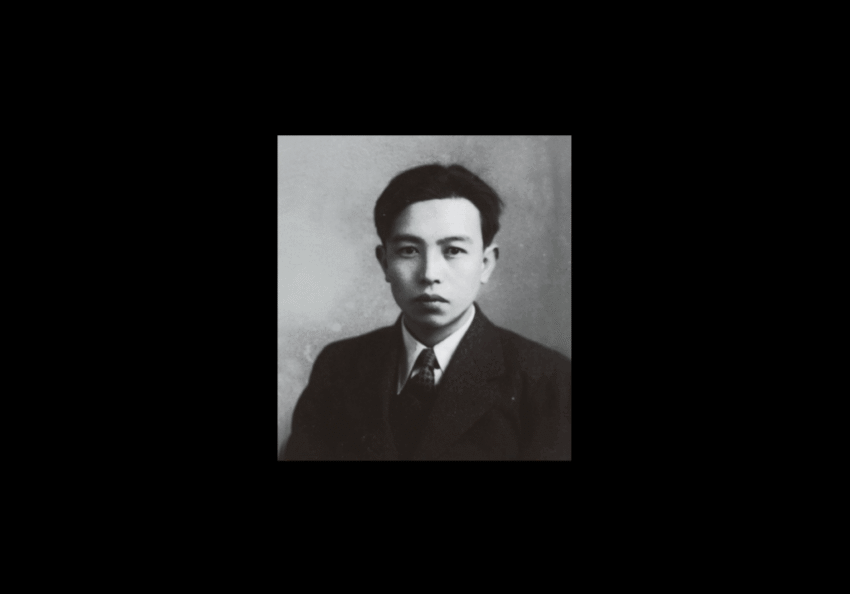
The writer in 1936. Nakahara family, Public domain, via Wikimedia Commons.
For our series Making of a Poem, we’re asking poets and translators to dissect the poems they’ve contributed to our pages. Jeffrey Angles’s translation of “Memory of a Three-Year-Old” appears in our new Spring issue, no. 255.
This is one of two poems you’ve translated for this issue by Nakahara Chuya. To start, could you tell us a little about Chuya and the poem’s backstory?
Nakahara Chuya (1907–1937) was a Japanese avant-garde Modernist poet. Although he had a short life and career, today he is one of the best-known twentieth-century poets, remembered for his intensely personal poems and unusual, striking diction. He is routinely included in Japanese-literature textbooks, and his poems have been set to music countless times. “Memory of a Three Year-Old” is a strange little poem that first appeared in the April 1936 issue of Bungei hanron (Literary counterarguments) and was included in Chuya’s second book of poetry, Arishi hi no uta (Songs of days that were, 1938), which was published not long after Chuya’s premature death from tuberculous meningitis.
The memory described in this poem seems to date from Chuya’s early childhood, shortly after he returned to Japan after a couple of months spent in Manchuria, where his father, a high-ranking military doctor, was stationed following the Russo-Japanese War. Whether or not he had a roundworm infection like the one described in this poem is a fact lost to history, but there was a persimmon tree in the courtyard of his home at that time. In a letter to a friend, dated April 12, 1936, Chuya comments that his son had recently turned eighteen months old. He fantasized about withdrawing to the countryside, where he could relax and play with his boy. It seems that thinking about playing with his son prompted Chuya to reflect on his own past.
What struck you when you first sat down with this poem?
Unlike in much of Chuya’s poetry, the language of this poem, which is written in modern, colloquial Japanese, isn’t especially difficult to understand. Most of the images are concrete. The only lines that give the reader pause are the final ones, in which the neighbor’s house goes flying into the sky—an image that Chuya specifically repeats twice, as if to underline how important and surprising it was. What happened here? Was the young boy so surprised by the sight of the parasites that he became dizzy, making it appear that the house was flying upward? Did the house appear to drift into the sky as the narrator looked at it through teary eyes? Were there a bunch of birds on the roof that suddenly flew up into the air, giving the impression that the roof was coming off? The presence of this unexplained mystery in the text—along with the decidedly nonpoetic image of the parasites—helps to establish the poem’s quirky, modern, iconoclastic feel.
Some scholars speculate that the poem may have been partially inspired by “Sekichiku no omohide” (Memory of pinks) by the poet Kitahara Hakushu (1885–1942), which describes a childhood memory of urinating off the edge of a veranda that is brilliantly illuminated by the sun, just like in Chuya’s poem, while taking in a vision of a painfully bright bed of red flowers.
What was the challenge of this particular translation?
When translating from Japanese to English, one is forced to make decisions that would probably never even occur to a Japanese speaker. Japanese does not typically distinguish between singular nouns and plural nouns. Unless the author specifies a number to say how many things they are talking about, the translator must decide whether to render the word as singular, one thing, or plural, multiple things. With this poem, this question of singular versus plural took on an unusually grotesque dimension. When the parasite slides from the narrator’s backside into the potty beneath, how many parasites are there? Is it just a single roundworm or many? I ended up looking at some pictures of roundworms on the internet that, frankly, I would have preferred never to have seen. Chuya mentions kaichu (蛔虫), which usually refers to Ascaris lumbricoides, a type of particularly large roundworm that, I learned, is the most common parasitic worm in humans around the world. I wondered if this type of roundworm would break into lots of little segments inside the body, like tapeworms—an utterly disgusting prospect!—thus necessitating a plural in the translation. My research yielded an even more awful truth—Ascaris lumbricoides are not segmented and are thus more likely to slide out whole and alive.
One website told me that the adults can grow to anywhere from six to twelve inches, depending on the worm’s gender. Another taught me that since they can often get as long and as thick as earthworms, they are relatively hard to miss. The Mayo Clinic finally concluded my trip down this stomach-turning rabbit hole by informing me that Ascaris lumbricoides often come out individually or in small numbers, but in cases of severe infection, they may appear in large, tangled masses. It is easy to imagine that even one of these thick, horrifying worms would be enough to terrify a child, but after looking at so many disturbing pictures on the internet, I personally couldn’t get the image of multiple worms out of my mind. In the end, I settled on the plural, concluding that even though it was possible the narrator passed only a single worm, using the plural roundworms would leave readers with an unforgettable image.
Orthography was another challenge here. Japanese has nothing like the difference between capital letters and lowercase letters, but one cannot avoid making choices regarding capitalization in English. Capitalizing the start of every line reminds readers of older, nineteenth-century poetry, whereas a more flexible approach toward capitalization can make the poem seem less bound by tradition. In translating this poem, I made the unusual decision to render the text in all-lowercase letters, hoping to put Chuya in conversation with poets like E. E. Cummings and Gertrude Stein, who disobeyed rules of capitalization and other orthographic traditions as part of their Modernist experiments. Interestingly, Chuya uses fairly conventional punctuation in his original, but the use of sentence-style verse in poetry was unusual for readers in the twenties and thirties, since a lot of Japanese poetry didn’t use punctuation at all. So, ironically, whereas Chuya included lots of punctuation to make his poem look new, fresh, and modern, I have removed all punctuation, hoping to give my translation a similar effect to the one it might have had on a Japanese reader of the time.
In one place, instead of the most common, standard Japanese phrase meaning “was shocked,” bikkuri shite shimatta, Chuya uses an alternative, colloquial variation, bikkuri shichimatta, that seems to reflect Chuya’s own speech habits, perhaps even his own southwestern Yamaguchi dialect. Unfortunately, no recordings exist of Chuya’s voice, so it is difficult to know how much the dialect of his hometown colored his everyday pronunciation. Colloquialisms come from specific places. I feared that using a specific regional variant—something like “I was gobsmacked,” which one is more likely to hear in England or Ireland, or “I was scunnered,” which one might hear in Scotland or northern England—might seem odd to readers in other parts of the world, especially since what is being described here, namely surprise, is such a straightforward notion. So I went with “shocked” after all.
What did the editing process look like for this poem? Were there any particular words or phrases that proved unexpectedly tricky?
The problem of the implied locality cropped up again when I submitted this poem to The Paris Review. To describe a type of toilet for children, Chuya uses the word okawa (稚厠), which is made up of two kanji characters meaning “infant, child” and “toilet, potty.” The editors, who grew up in different parts of the world, had different opinions about which words for such a seemingly universal thing sounded the most natural. In a flurry of emails, we debated the merits of various possibilities. Potty, a vernacular diminutive of the word pot, which has roots in nineteenth-century Britain but is also common in America, was suggested by one editor, but I rejected it because I thought it could invite misinterpretation—one might interpret it as a child’s word for the same toilet an adult might use, not a smaller, portable version for child use. Potty chair, which appears on some toilet-training websites, sounded unfamiliar to me, whereas another editor commented that it might have a note of “false cuteness,” like something a child, not an adult, would say. In the end, we concluded our amusing and slightly absurd email chain by settling on the more neutral training toilet.
When did you know this translation was finished? Were you right about that? Is it finished, after all?
If the goal of translation is to approximate the original as best as one can, I’m not sure that a translation is ever completely finished. Every time I read from one of my translations in public performances, I find myself wishing I had used some other turn of phrase, and so I continue to edit, making editorial comments in my book right there on the spot. One can continue polishing any translation forever. The question, simply, is when one feels ready to release it into the world so that it can take on a life of its own. With this poem, that moment came when I realized I couldn’t spend another second thinking about parasitic roundworms.
Jeffrey Angles is a poet, a translator, and a professor of Japanese literature at Western Michigan University.
Sports News
website focused on news and information about the world of football. This is one of the popular websites in Indonesia accessed by sports fans, especially football enthusiasts, to get quick and reliable information.