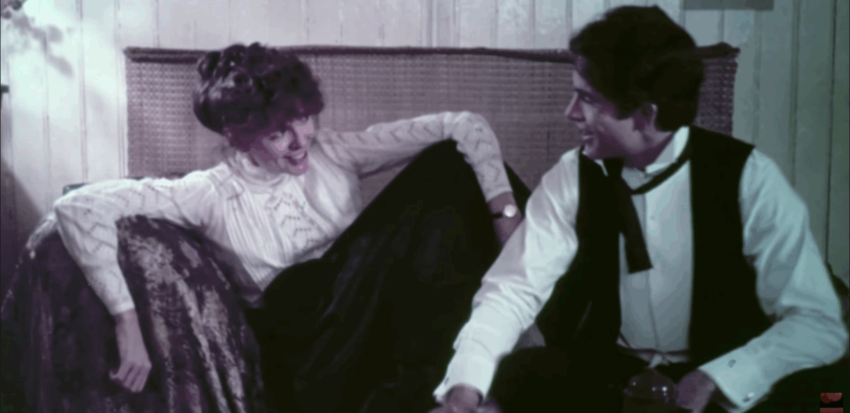
Still from the movie Reds. Screenshot from official trailer.
What are we ever really fighting for? The answer is love. Love in the movies, and on the streets, and in our heads—instead of the dead people we are seeing right now. Existence is a contagion of love. That’s why you have to fast-forward through a bunch of scenes in Reds, where men are giving speeches to other men in English and Russian with those faces of certainty—not hope, but certainty—that they are right and have it all figured out.
You know those men. You’ve been to those meetings with the guy in the front—it could be a faculty meeting—the guy jabbing his finger, not like Mick Jagger in a dance routine, more like Moses holding a tablet. Those guys who love the sound of their voice more than they love love. Everyone has been to one of those meetings, or hundreds of them, wondering how they were still breathing with all the air sucked out of the room. A fair number of these scenes interrupt Reds, which runs for more than three hours and has an intermission, like Lawrence of Arabia and 2001: A Space Odyssey, both excellent movies, as is Reds, if you gently fast-forward past the speeches and get back to John Reed and Louise Bryant, a love story.
Warren Beatty is his customary charming self as the socialist revolutionary and journalist John Reed, most famous as the author of Ten Days That Shook the World, his eyewitness coverage of the Bolshevik revolution of 1917. No actor on screen has ever been more convincing at playing a man who loves women. I don’t mean lusts after them. I mean needs them to feel at home in the world. I mean that combination of yearning and peace that falls over his face when he looks up from burrowing into the neck of a woman. See him in Splendor in the Grass with Natalie Wood, one of the great films about erotic attraction that’s almost too painful to watch. In all his films, Beatty radiates a befuddled sexual desire for women that he can understand and resist about as well as a dog can pass up a steak outside a restaurant.
Diane Keaton, too, plays herself as the writer and reporter Louise Bryant, and as Eugene O’Neill, Bryant’s sometime lover, Jack Nicholson plays Jack Nicholson—I mean, he gives exactly the same sweaty-snarly-smug performance he gave in Carnal Knowledge. How did this guy ever get a woman in real life? He must have something he doesn’t show the camera.
Here, often, Keaton’s shtick comes off as petulant and indecisive more than it shows us the independent-minded feminist and suffragist Bryant was. It’s the performance she gives in her movies with Woody Allen, where her frizzy-haired neurosis-girl works as a comic foil for Allen’s nebbishy pursuer. In Reds, you feel the long arm of the men, Beatty and Trevor Griffiths, who wrote the screenplay—Beatty also directed—not knowing how to write a female character that they maybe wouldn’t want to fuck. The real Louise Bryant went to Russia with John Reed, as does Keaton’s Bryant, and was maybe just as annoying as Keaton’s Louise. I don’t know. It’s still hard to be a feminist without arousing wave after wave of confusion and aversion. This I promise.
It’s fun watching these actors play themselves while pretending to be people living in the early twentieth century. It’s fun to look back at the actors as they were forty-five years ago because you are also looking at yourself watching the movie for the first time—Richard and I both saw it when it came out. Reds is threaded with talking-head “witnesses,” interviews with real labor organizers and writers who knew John and Louise, among them Henry Miller, Will Durant, Adela Rogers St. Johns, William Weinstone (a founder of the U.S. Communist Party), Rebecca West, Hugo Gellert (artist for The Masses—Reed’s journal), and scores more. A few keenly recall a detail here and there, but most of them are hazy and inexact, falling back to personal anecdotes and petty grievances that have nothing to do with the subjects at hand and come off like those irritating narratives that people clutter comment threads with on social media.
What is lasting in memory? What does a revolution want? These are questions the movie keeps asking. Reed is vigilant about withdrawing his writing from editors who want to slant his words to their own ideological ends. In a stirring exchange with Zinoviev (Jerzy Kosiński) on a train in Russia, he says, “Zinoviev, if you don’t think a man can be an individual and be true to the collective, or speak for his own country and the International at the same time, or love his wife and still be faithful to the revolution, you don’t have a self to give! … When you separate a man from what he loves the most, what you do is purge what’s unique in him. And when you purge what’s unique in him, you purge dissent. And when you purge dissent, you kill the revolution! Revolution is dissent!”
Which brings us back to love—to the reason there are movies in the first place and this movie in particular. We go to the movies not for debates about how this left-wing faction must splinter off from that one. We go not for the war being fought off-screen in Casablanca but for the “hill of beans” love story between Rick and Ilsa. Reds is great, with its nod to Doctor Zhivago—the lovers separated and trudging through God knows what snow and ice to be reunited.
John has only one kidney and his remaining kidney isn’t doing great. He travels to Russia without a U.S. passport, and the Russians detain him from going home. Meanwhile, Louise stows away on a merchant ship to reach him and doesn’t receive the telegrams he sends. He feels she has stopped loving him, and this rips your heart out because none of this would be happening if they had cell phones.
The movie is great as Louise makes her way through Russia to find John and save him. It’s great because of the wash of 1981 over the characters and events of 1915 to 1920, and the way Richard and I could see our younger selves, who believed that social transformation could be willed into human DNA. We still have those ideals but no navigation system for how to get there. The movie is great, even though Diane wears some kind of flashback Annie Hall hat in every shot and then later, in Russia, one of those schmattas that every female character in the history of cinema has had to wear as soon as they go to Russia. I love that Louise finds John before he dies of kidney failure at age thirty-two. I love that he dies knowing he is loved. I love being transported to where the movies take you. Out of your life and also into it.
Laurie Stone is the author of six books, most recently Streaming Now: Postcards from the Thing That Is Happening, which was long-listed for the PEN America Diamonstein-Spielvogel Award for the Art of the Essay. She is a frequent contributors to The Paris Review online and her Substack is Everything Is Personal.
Sports News
website focused on news and information about the world of football. This is one of the popular websites in Indonesia accessed by sports fans, especially football enthusiasts, to get quick and reliable information.